In the Long Run We Are All Dead by Geoff Mann
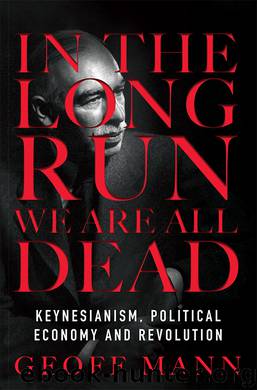
Author:Geoff Mann
Language: eng
Format: epub
Publisher: Verso Books
CHAPTER 11
How to Read The General Theory III
The principal objective of all varieties of Keynesianism, including Keynes’s own, is always formulated in relation to classical and neoclassical orthodoxy: a scientific theory more adequate to the world than that it attempts to supplant. The theory of involuntary unemployment epitomizes this approach. Falsifiable empirical “facts” about the world “in which we actually live” sustain the logic of the Keynesian position: in modern capitalist markets, structural rigidities and unrealizable institutional capacities and informational requirements mean laissez-faire simply cannot deliver on its promises. The limits to capitalism are endemic to the mode of production itself, because it is always populated by agents so constrained.
Today this positivist framing dominates because most self-described Keynesians avoid an explicitly political argument for Keynesianism. They tell us we should commit to Keynesianism not because it is more just, egalitarian, or ethical—although they might think so—but for the simple reason that it is truer, its explanation of how the world works more rational and logical than classical and neoclassical dogmatism. They maintain that Keynesianism is just better science, the crowning achievement of centuries of economic reason. As any reader of Paul Krugman’s New York Times editorials knows, we should all be Keynesians because we are civilized moderns, with access to a true science of the world as it actually operates. (Indeed, for Krugman, anyone who is not his kind of Keynesian is deluded.) This account happily accepts the orthodox motivational assumptions of homo economicus, and in that sense is as beholden to Ricardo, de Mandeville, or the vulgarized “invisible hand” as any “freshwater” neoclassical. The problem Keynesian science shows is that the world and the bodies and minds with which we must live inevitably impinge upon this idealized behavioral infrastructure. To Keynesians, Keynesianism is thus the enlightened recognition of the worldly fetters on and of human nature.
Keynes’s argument for his theory (like Krugman’s) was often couched in a similar disdain for orthodoxy’s willful blindness to the “facts of experience.” But he was much quicker to defend it as an enlightened politics, because he believed Keynesianism explained both the causes and the political implications of involuntary unemployment—and thus of poverty. The General Theory explained the forces that produce involuntary unemployment, the means through which it could be addressed, and—most important—the political-economic reasons it must be addressed. Although rarely framed as such by today’s Keynesians, this more than any particular illuminated Truth helps explain the ongoing appeal of Keynesian thinking across decades of increasingly frequent crisis. In sharp contrast to both the smooth progress mythologized by classical and neoclassical theories and the dire diagnoses of some varieties of radical analysis, Keynesianism aims to provide a nonrevolutionary pharmaceutical science, of and for crisis.1
Indeed, one might define Keynesian reason as the scientific form of a political anxiety endemic to modernity.2 It is always a product of, and is sustained by, those terrible moments when liberalism’s and capitalism’s shared salto mortale—the impossible commitment to the idealist separation of what Poulantzas called the economic and political “regions” of the lifeworld—is exposed as an act of raw political will.
Download
This site does not store any files on its server. We only index and link to content provided by other sites. Please contact the content providers to delete copyright contents if any and email us, we'll remove relevant links or contents immediately.
| Anthropology | Archaeology |
| Philosophy | Politics & Government |
| Social Sciences | Sociology |
| Women's Studies |
The Secret History by Donna Tartt(18989)
The Social Justice Warrior Handbook by Lisa De Pasquale(12175)
Thirteen Reasons Why by Jay Asher(8869)
This Is How You Lose Her by Junot Diaz(6853)
Weapons of Math Destruction by Cathy O'Neil(6242)
Zero to One by Peter Thiel(5757)
Beartown by Fredrik Backman(5703)
The Myth of the Strong Leader by Archie Brown(5479)
The Fire Next Time by James Baldwin(5405)
How Democracies Die by Steven Levitsky & Daniel Ziblatt(5193)
Promise Me, Dad by Joe Biden(5125)
Stone's Rules by Roger Stone(5062)
A Higher Loyalty: Truth, Lies, and Leadership by James Comey(4936)
100 Deadly Skills by Clint Emerson(4898)
Rise and Kill First by Ronen Bergman(4752)
Secrecy World by Jake Bernstein(4721)
The David Icke Guide to the Global Conspiracy (and how to end it) by David Icke(4671)
The Farm by Tom Rob Smith(4482)
The Doomsday Machine by Daniel Ellsberg(4467)
